Friday, April 04, 2014

National Pet Week 2014 CUTEST PET PICTURE CONTEST


A BIG THANK YOU to everyone that participated in this year's Facebook Cutest Pet Picture Contest!  It was a lot of fun seeing all the adorable pictures that were submitted!!  The winners will be contacted via Facebook message.

Congratulations to our winners!!!


FIRST PLACE:
B. Sander--57 Votes!


SECOND PLACE:
G. Riede--18 Votes!!

THIRD PLACE:
J. Chobanich--17 Votes!!

AND AGAIN, THANK YOU TO ALL THE OTHER PARTICIPANTS AND THEIR ADORABLE FURRY FRIENDS!!!

C. Franklin

C. Webb

C. Wenger

D. Aragon


A. Chan

J. Beam

 P. Le

T. Lester


 C. Condos

 K. Auch

M. Jones

P. Lindell
S. Cabelera
 H. Bar

 S. Mariano
G. Hinz
J. Worley-Pearson


 J. Reptiles
R. Posmanter
K. Orth
 S. Swinney
 B. Griffin

D. Audette
P. Shotswell
A. Ngo
B. Berzin

Monday, March 24, 2014

Trauma and Healing – It can happen!

Written by Dr. Gloria Ku

A few months ago, we saw a young dog that had a constriction trauma to his paw.  When he first presented to us with his problem, Shiloh’s paw was almost 3x its normal size due to the swelling and constricted blood circulation.  His toes were swollen and spread out like a fan, and his whole foot was purple in color.  But sweet as he is, he still wagged his tail and hopped around on his other three legs greeting us all that day.


After initially wrapping his paw with daily wrap changes, at times using a sugar wrap to draw out the edema (swelling) as well as diuretics, antibiotics, pain medication, and lots or care and attention by staff and family alike, Shiloh’s foot began to shrink back to its normal size and shape.  The skin over the injured area and the foot were challenged by the extreme swelling, and eventually sloughed off.  But we knew that he still had feeling in his toes even though initially he couldn’t move them due to the swelling.  Because of the loss of protective skin tissue, he was also at high risk for infection.  In time, the swelling subsided and granulation tissue (precursor to new skin) formed and healed over the underlying muscle and tendons, until eventually the hair even began to grow back.  It has taken about 6 weeks, but we are now comfortable that his paw will be fine.   
Here are a series of photos taken during the progression of his care to give you an idea of how these types of wounds heal. 
Thanks for sharing them, Shiloh!  Happy trails!!


Friday, February 07, 2014

My Collar Was Too Big...And Then Too Small!

After several months of watching a little wild kitten come to their cat’s feeder, an Elk Grove couple was finally able to trap her.  They had noticed her several months earlier, a little tiny black kitten with a collar that dangled on her like a necklace practically.  After a short while, it became evident that the collar had shifted into more of a banner, draping down around her left arm and around her neck.  As the weeks passed, the kitten grew.  She was very frisky and quite wild, and catching her had been attempted multiple times without success.  Finally, it was clear that she must be trapped and needed help.  The kitten had grown so much that the collar had begun cutting into her skin and had become embedded into her neck and armpit.  The secondary infection that developed, may have weakened the kitten just enough to finally catch her. 

When she arrived at our practice, her odor preceded her.  The nice couple who had taken such pains to catch her and bring her in, wanted to know what could be done, if anything, to help her.  In the hour between catching her and getting her in for an appointment, they had already given her a name, “Sooty”, after a puppet character from a well know British children’s program.  Perhaps that was a turning point for this kitten as her injuries from the collar - once too loose, now too tight - were extensive.  She had a banner type laceration extending nearly circumferentially around her body separating the skin on her head and neck from the rest of her body except for about a 1-1/2 inch strip.  


To repair the injury was expensive, and took over an hour in surgery.  But it didn’t take her new people long to agree to the repair, as otherwise she was sure to expire from infection and pain.


After surgery she had several drains and 100 sutures.  She wore a little t-shirt to protect the area from her own scratching and self-grooming, until the wound healed.  She had antibiotics and pain medication, and in almost 3 weeks, all was healed.   

Since then little Sooty has grown another 1-1/2 lbs., had her vaccinations, and been spayed.  She is now a happy member of her new family and is grateful for her new home.  We will probably never know what happened to the person(s) who initially put her collar on her, thinking they could care for her properly but then somehow not being able to follow through.   Luckily, others in their neighborhood were able to correct their mistake.   It really does take a village!


Thank you Sooty for letting us tell your story!


Thursday, January 02, 2014

Does My Pet Really Need to Have A Dental Cleaning?

Written by Dr. Gloria Ku

Recently “20/20” aired a segment with a veterinarian from Canada who admitted to padding his services with unnecessary dental cleanings in order to raise revenue due to pressures of operational costs.  He mentioned giving injections and a few other things that he admitted to doing, and now saw fit to “come clean” and “tell all.”  Sadly, the veterinary profession is not immune to unscrupulous practitioners who might take advantage of clients’ good intentions.  But to generalize that more than the rare veterinarian would risk anesthetizing a healthy pet for an unnecessary procedure, and assume that liability, would be a mistake.  Another disappointing aspect of this segment is that it ignores the important and likely more common occurrence, where guardians do not take the gravity of dental disease seriously enough.  With National Dental Health Month just around the corner, we hope you will take the opportunity to evaluate the benefits of oral hygiene for your pet on an individual basis. 

A thorough prophylaxis, or cleaning, performed on a routine basis, when tartar and plaque accumulation threaten to develop into periodontal and gum disease, can be very helpful in preserving teeth for the lifetime of our pets.  This will also prevent infection from spreading to other areas of the body, potentially resulting in secondary endocarditis (heart valve infection), urinary tract infections or liver infections.  A typical cleaning at our practice will have “before” and “after” photos like this:

While our preference is to clean the teeth prior to heavy tartar accumulation, often this is when owners are noticing bad breath and appreciate more the value of the cleaning.  Even with less tartar you can start to get gingivitis, as indicated by the redness along the gum line and between the larger molar and premolar on the bottom, seen even after cleaning here:


Worse situations may develop when tartar and plaque lead to gum recession or root infection, and the tooth has to be extracted, as in this example:


Here the gums and gingiva are very inflamed and infected, making the extraction more of a health risk for spreading bacteria throughout the body, or worse, developing a blood born bacterial infection. In cases of multi-rooted teeth, the surgical extraction can also be difficult and expensive. The surrounding tissue and bone is also infected in this case, causing irritation to the tissue left behind even after the extraction.
Non-anesthetic dentistry is also being offered at some clinics and through some pet stores.  Please be aware that all dental cleanings involving scaling instruments are illegal without the supervision of a veterinarian on site in the state of California.  In some cases, there have been companies that offer veterinary supervised cleanings without anesthesia.  For the most part, these procedures are not considered appropriate by the vast majority of the veterinary community, because adequate cleaning and probing cannot be done without anesthesia. “AAHA [American Animal Hospital Association] and the AVDC [American Veterinary Dental College], along with many others in the veterinary community, agree that the procedure isn’t thorough enough, could cause more damage and does a disservice to patients – and to their owners, who think their pets’ teeth are getting cleaned at an appropriate level.”[1] 
There are a number of home care options that can minimize the need for dental work under anesthesia. Brushing daily with an edible paste for dogs and cats, e.g., CET paste, is highly recommended.  Appropriate chew toys, diets and treats can also minimize the rate of tartar accumulation. But for the majority of pets, at some point, a deeper cleaning under anesthesia is warranted.  Your veterinarian should be able to help you determine when that will be, and what the risks are for both not doing it, and doing it.  Then you can decide for your pet.  Like children, they depend on their guardians to take care of them.  We hope to help you make the best informed decision possible, in line with your own health care philosophy, budget and practical application. 


[1] Dvm360, November 2013, page 13

Friday, December 20, 2013

Global Animal Health – What can you do?

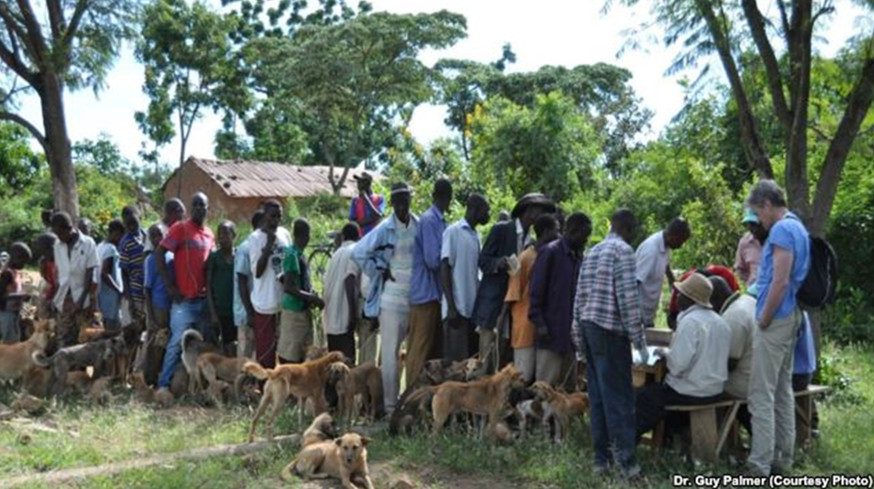
There are many global animal health issues, but one that begs for the attention to any pet owner relates to dogs and rabies.  Herein the US, we have become so accustomed to pet ownership being associated with rabies vaccination, that we no longer remember a time when it was not.  Rabies is a virus which attacks the nervous system and is 100% fatal.  In the past century, human deaths associated with rabies in the US have declined from 100 deaths per year to only 2-3 per year.  This has been largely attributed to vaccination programs and animal controls established in the 1940’s, oral vaccinations introduced in the 2000’s, and the development of human rabies vaccines and immunoglobulins to prevent infection.   In this country we can safely say that the domestic dog is no longer a reservoir for this disease. [1]

In other parts of the world, particularly South Asia and sub-Saharan Africa, people, and dogs, are not so lucky.  It is reported that there are 50,000-60,000 deaths per year attributed globally to rabies, most occurring in these two regions.  Many of these deaths are young boys, because they are often the care givers of the domesticated dogs, and will get bitten on the head or face where the virus can spread quickly to the central nervous system before human vaccines can be administered.  Dr. Guy Palmer, and a group of veterinarians working at Washington State University have begun a new program called the Paul G. Allen School for Global Animal Health.  One of their projects currently is to make rabies vaccination of domesticated dogs available, and sustainable, in these communities.  Their research has shown that if we can vaccinate just 60% of the domesticated dog population, we can essentially eliminate rabies outbreaks in a community.   And if we can move outward from a controlled population, we can widen the area of control quickly and efficiently.  The surprise to researchers has been the willingness and eagerness with which the human guardians of these dogs line up for vaccinations.  The will is clearly present.
 

But the cost for vaccination programs is reliant on donor support.  The hope is to develop more heat tolerant vaccines (keeping vaccines cool adds nearly $1/vaccine to the cost), and minimize transportation costs by being able to store vaccines on site.  These changes will markedly reduce costs and allow programs to become self-sustaining in the future.[2]  Their research efforts, as well as vaccination programs, are helping to change the course of this devastating disease, while strengthening the bond between canines and humans.  
Please join us in supporting their efforts this year.  This is a program with tangible results that will save both human and animal lives.  You can make a donation the next time you are in our hospital, or online at http://globalhealth.wsu.edu/giving/index.html.

Thank you for taking time to consider how we at home, can still make a difference, and make the planet safer for people and their dogs.  Happy Holidays!

The Staff and Doctors at Hatton Veterinary Hospital


Monday, December 09, 2013

Accidents Happen! (CAUTION: GRAPHIC PICTURE!)

9 am: there is a rush in the door.  “My dog has been shot with a paintball gun!”  Blood was streaming slowly from her face as Reyna, a 66 lb. Staffordshire Terrier, is carried in by her emotional and worried owner.  “She had been inside, the garage door had been shut, I was doing target practice, I don’t know how she got out…”  Reyna’s owner was beside himself, and seeing his dog like this, he could hardly speak.  Reyna was calm and as sweet as could be.  But we knew we had to do something. Her eye had apparently taken the paintball squarely across her cornea.  The blood was thick and it was difficult to discern where normal tissue, if any, still remained.  Reyna was so calm. We put a numbing agent in her eye and tried to apply a cold compress to slow the bleeding and swelling down while we got more information.  Her gums were nice and pink still, and her heart sounded normal.  Reyna had to have a headache but she was calm and let us examine her.  We got permission to give her some pain relief and identified that the top layer of the cornea, the protective layer on the surface of her eye, seemed to be torn.  It was unlikely we could save the eye.  Colored paint adorned her face.  It was now clear to all of us why goggles and other protective head gear are important…

Soon Reyna was resting more comfortably and the bleeding subsided.  She went into surgery shortly after that and her eye was enucleated (removed).  This was the only reasonable choice, both from a financial and a humane standpoint, to minimize her trauma and get her back to her normal happy life as quickly as possible. 
Two weeks later, Reyna is a happy dog again! Despite having spent two weeks in an E-collar, she is wagging her tail and getting around as if nothing had happened.  The forgiveness and unconditional love of a dog is truly remarkable.  The love of a family that had to find the unexpected funds to take care of her accident is also remarkable.  We must be careful out there, even when we are just having fun!

Friday, November 01, 2013

Is there Wildlife in my Backyard?

There could be.  Racoons, skunks, opossums, squirrels, voles, mice, rats… these are just a few of the possible “wild” animals that can be in most residential neighborhoods in Sacramento/Elk Grove on any given night.  Except for squirrels, these critters are primarily nocturnal, and can and will travel over fences and through sewer and runoff drains.  Often as the weather cools and the rains begin to flood out previous shelters, these animals become more apparent to us, and our dogs, in the late Fall and early Winter.  The holidays for us are often marked by the baying of our coonhound as he discovers yet another raccoon in the tree, or opossum in the garden.  I am always grateful when he does not discover a skunk!


Photo Source: http://en.wikipedia.org/wiki/File:Urban_raccoon_and_skunk.JPG

In recent years, skunks and raccoons have been associated with rabies, and therefore present a risk to us and our pets more than the nuisance or bad odor we smell when a skunk  “sprays.”  As in this picture, they are often attracted to cat food or dog food left outside, or drawn into homes through pet doors to such feeders.  Although a skunk will be reluctant to spray initially (they have about 15cc stored up which takes about 10 days to make), they will not hesitate when confronted with an attacking dog, or cat, or person with a broom.  However, being omnivores, they are attracted to all that our gardens and kitchens and garbage cans have to offer; Urban dwellers are increasingly common as well.

The best thing to do is to keep food from being readily available, and to check sheds and outhouses regularly to be sure animals have not taken up residence.  Rodent baits are regulated now so that they can only be put out in closed bait traps to prevent pets and children from accidentally consuming them, but they are not entirely dog proof and extreme care should be taken when one choses this route.  Several different types of “bait” are utilized, some of which have antidotes, and some of which do not. Some of the newer rat baits are neurotoxins and dose-dependent, others cause inability for the blood to clot.  If your pet should accidentally ingest any rodenticide, it is important to know the exact ingredients and the quantity consumed.  Emergency care should be sought immediately, and packaging brought with you as several types look similar to one another but are treated differently. 

Photo Source: http://en.wikipedia.org/wiki/File:Raccoon_(Procyon_lotor)_2.jpg
One last concern to consider before taking too kindly to these interesting creatures is Leptospirosis.  This is an infection caused by a bacterium carried in the urine or feces of infected animals. The most common reservoir in urban areas would include mice, rats, raccoons, etc.  Dogs and people can be infected by contact with food, water or soil containing urine from infected animals.  Infection can also occur when dogs drink from standing water sources including rain puddles, creeks, streams and run off.   Dogs can and should be vaccinated against this, but no vaccine is 100% protective, and most dogs have not been vaccinated as regularly for this disease as the vaccine was not updated to accommodate current strains until recently.  It is the world’s most common disease transmitted from animals to humans, and causes acute kidney failure and often death if not treated in time.
So before you decide to let that cute raccoon feed out of the cat’s outdoor dish, or let the mice and voles have the last of this year’s garden fruits, consider the risks and protect yourselves accordingly.  Happy outdoor urban adventures!
 

Tuesday, October 15, 2013

What If Your Teeth Kept Growing? ALL THE TIME?!


Photo Source: http://www.countryliving.com/
That’s what happens with rabbits and chinchillas, rats and mice.  In fact, most “rodents” have continuously growing teeth that wear down as they eat.  Occasionally, there are problems with malocclusion (poor alignment of the teeth).  This can be a genetic or inherited problem, or can result from some type of injury. 


Photo Source: : http://www.veterinarycentre.co.nz
Photo Source: http://www.mohrs.org/hrswebpg23.html
If the front teeth are not aligned, we can usually see that on a routine physical exam, and either trim the teeth to allow them to function well enough for most pet rodents to still eat, or consider surgical removal of these teeth.   If the back molars do not meet up, it can be harder to detect the problem.  Sometimes we don’t realize there is a problem until the pet stops eating, or starts drooling excessively. 
The reason for this is that a rodent’s large cheek pouches make visualization of these back molars nearly impossible without anesthesia and x-rays.   Luckily, poor alignment of the rear molars is less common than the front incisors, because when it happens it can often lead to more serious problems and can be costly to treat.


Thursday, September 05, 2013

A Dog Named Lucky


One of our clients sent us an email with this story...it touched many hearts here at the hospital, so we decided to share it.  Enjoy!
 

"Anyone who has pets will really like this. You'll like it even if you don't and you may even decide you need one!

 Mary and her husband Jim had a dog named 'Lucky.'   Lucky was a real character.

Whenever Mary and Jim had company come for a weekend visit they would warn their friends to not leave their luggage open because Lucky would help himself to whatever struck his fancy.   Inevitably, someone would forget and something would come up missing.
 
Mary or Jim would go to Lucky's toy box in the basement and there the treasure would be, amid all of Lucky's other favorite toys.     Lucky always stashed his finds in his toy box and he was very particular that his toys stay in the box.

It happened that Mary found out she had breast cancer.   Something told her she was going to die of this disease......in fact;  she was just sure it was fatal.

She scheduled the double mastectomy, fear riding her shoulders.   The night before she was to go to the hospital she cuddled with Lucky.   A thought struck her....what would happen to Lucky?   Although the three-year-old dog liked Jim, he was Mary's dog through and through.

 If I die, Lucky will be abandoned, Mary thought.  He won't understand that I didn't want to leave him!  The thought made her sadder than thinking of her own death.

The double mastectomy was harder on Mary than her doctors had anticipated and Mary was hospitalized for over two weeks.   Jim took Lucky for his evening walk faithfully, but the dog just drooped, whining and miserable.

Finally the day came for Mary to leave the hospital.   When she arrived home, Mary was so exhausted she couldn't even make it up the steps to her bedroom.    Jim made his wife comfortable on the couch and left her to nap.

Lucky stood watching Mary but he didn't come to her when she called.    It made Mary sad but sleep soon overcame her and she dozed.
When Mary woke for a second she couldn't understand what was wrong.   She couldn't move her head and her body felt heavy and hot.   But panic soon gave way to laughter when Mary realized the problem.  She was covered, literally blanketed, with every treasure Lucky owned! 

While she had slept, the sorrowing dog had made trip after trip to the basement bringing his beloved mistress all his favorite things in life.

He had covered her with his love.


Mary forgot about dying.   Instead she and Lucky began living again, walking further and further together every day.   It's been 12 years now and Mary is still cancer-free.   Lucky.   He still steals treasures and stashes them in his toy box but Mary remains his greatest treasure.

 
Remember.....live every day to the fullest.  Each minute is a blessing.  And never forget....the people who make a difference in our lives are not the ones with the most credentials, the most money, or the most awards.   They are the ones that care for us.

If you see someone without a smile today give them one of yours!   
Live simply. Love seriously.   Care deeply.   Speak kindly. 

A small request
All you are asked to do is keep this circulating, even if it is only to one more person, in memory of anyone you know that has been struck down by cancer or is still fighting their battle."

Friday, June 21, 2013

The Sky is Falling!! The Sky is Falling!!!!


(Photo Link: blog.dogvacay.com)
Every year on the 4th of July - and in our neighborhood for several days before and after the 4th of July - there can be heard the shrill whistle, pops and cracks of firecrackers.  For many of us, it brings back memories of warm summer evenings, picnics, and family barbeques with watermelon and corn on the cob.  But for many dogs it signals the return of two things: Fear and Anxiety. 
One year, we happened not to go out to see the display, and realized that our dog, Kona, was terrified when the whistles and bangs went off in earnest about 9:30 pm.   First, she started by pacing back and forth, and drooling.   Then asking to go out and coming back in, and then back out again until she finally lay down behind the couch (not a spot she frequented).  She panted and quivered until we turned on the AC, shut the windows, and turned up the television.  Still, despite the distraction, she trembled quietly at my feet until nearly midnight.   Years later, she lost her hearing and it no longer became an issue, but clearly her anxiety was real and all the physical signs of stress and fear came to the surface.  I was grateful (and so was she) that we had witnessed her reaction so that we could make the appropriate preparations the next year.
After attending a conference in Seattle later that year, I learned from a veterinary behaviorist from Pennsylvania about her own dog who reacted the same way to thunderstorms.  She had discovered that her dog’s anxiety was alleviated by a low dose of anti-anxiety medication known as alprazolam.  It turns out that if dosed appropriately a few hours in advance of anticipated storms (or fireworks), and repeated shortly before the events escalated, her dog (and mine) would settle down and sleep instead of pacing, panting, hiding, and shaking.  In the years that followed, I have supplemented my treatment of anxiety in dogs with a combination of sedation and anti-anxiety medication that seems to work better for most dogs with firework anxiety. 

(Photo Link: madmikesamerica.com )
So for all those dogs out there that experience the anxiety and fear of loud falling lights from the sky, there is hope!  Speak to your veterinarian and prepare for this in advance of a problem this year.  Not all solutions will involve medication depending on the degree of distress.  Your veterinarian can help you decide what is best.  Our dogs, with their super strong hearing, don’t have to dread this curious holiday with falling skies any longer!!