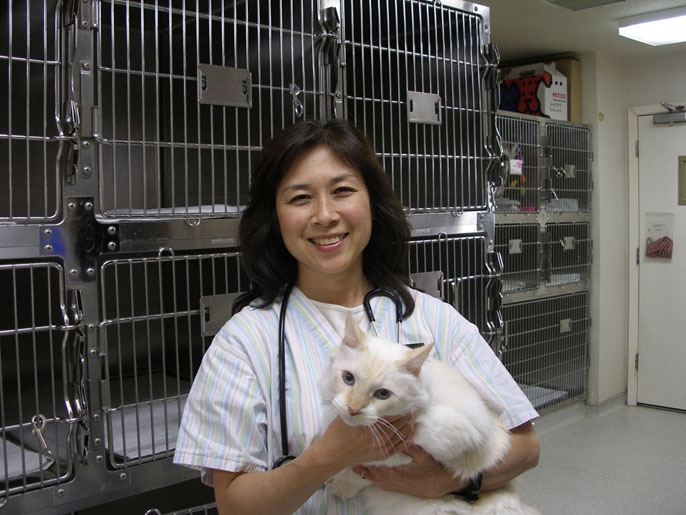
Blog page for Hatton Veterinary Hospital, a full service veterinary hospital in Elk Grove, California. Blog will hopefully allow clients and staff a forum for questions and new information updates.
In the summer of 1994, less than a year after we opened, Lightning came to us as a kitten in need.Some of the current staff was here when he first came in.His housemate, a big lab, was a little too exuberant for poor, tiny Lightning and he came to us limping.We did not find any serious injuries, but the owner did not think he was safe at their house any longer.Lightning worked his charm on all of us, most importantly Dr. Hatton, who finally decided he could be our hospital cat.
As a kitten, he got into EVERYTHING, but we overlooked his mischief because he was so darn cute and loveable.Ideally, a hospital cat should “earn his keep” by being tolerant to different treatments. That way, we could demonstrate procedures with him to show other pet owners.Lightning did not agree!He loved all his caretakers, but being a cat, he called all the shots!
He did not like strangers or even well meaning clients.It was quickly obvious that we would provide his every need but he had no obligations to us except for affection on his terms.For almost 18 years, he was a constant source of joy, frustration and always entertaining.Lightning decided (on his terms as always) it was his time to leave us this past May.He was a member of our family, and we will never forget him!Rest in peace Lightning, we love you and miss you!
Having a senior pet is quite different than a younger pet for many reasons.Not only is there a stronger emotional bond after living together for many years, but the aging process in animals happens so much quicker than it does for people that it sometimes feels “sudden” that they are now “old.”
Like people, pets can cling to old habits and mentally, they may want to do the same things they have always done (run with you, go to the park, eat everything they are presented with, jump onto the bed or couch, etc.), but physically, those things may become more difficult to do.Sometimes it is a challenge to relearn how to get onto the bed more safely, or when to stop running for the ball.As their caregivers, we also have to be reasonable about what we ask them to do.We may need to adjust our routine, walk a shorter distance with them, put a step stool or bench at the end of the bed, or provide a lower perch or more steps up to the cat post.We may need to be more careful about the foods we offer, raise the food bowl, or put down non-slip floor mats to help them eat or drink on their own.We also can be careful not to over feed them (out of love) to the point that it is more difficult for them to move (or even breathe!) sometimes.
When we think our pets are no longer as comfortable as they once were, it is a reasonable time to have a discussion with your veterinarian about their quality of life and what options are available for comfort care.More frequent visits and health checks to ensure they don’t decline prematurely just makes sense.Sometimes medication can be recommended to help with arthritis, or alternative treatments for indigestion or incontinence.Often we assume that age may be the reason for their lethargy, or weight gain, or incontinence, and fail to see that it is actually a correctable medical problem that could be the beginning of something worse if unchecked.Or maybe one just needs reassurance that what we are seeing is a normal aging process rather than a medical or behavioral issue.And occasionally it is time to consider whether a pet is actually suffering or not.
It is not easy to contemplate euthanasia.The fact that our pets’ life spans are shorter than ours makes it likely that if we are lucky enough to have a pet reach their senior days in our care, we will need to consider the option of euthanasia to help them transition “to the other side” as humanely as possible.We recognize the importance of allowing our pets to pass with dignity and without pain.One of the questions I always ask myself is if my pet is still having more good days than bad, and whether or not they are able to appreciate the things in life that they normally enjoy (e.g. spending time with their people, eating, drinking, resting).If the time comes when that is no longer the case, and we can’t mitigate the discomfort, euthanasia may be the best for our beloved pet.I encourage you to have a discussion with your veterinarian and your family about what is best for your pet, and for you.It is not the same for everyone.We have all hoped that somehow Fluffy would pass quietly in the night, but unfortunately that rarely happens.Our pets give us years of unconditional love.They depend on us to help them with their transitions as much as we are able.
But in the meantime enjoy the journey because it is sooo wonderful!Don’t you agree??
Seizure disorders in dogs are more common than you would think, so it is important to be able to recognize them, and what can cause them.In general, a seizure refers to involuntary movement associated with neurologic (brain) activity that is firing at an abnormally fast rate.What does that look like?You may see shaking, tremors, involuntary elimination, and sometimes falling over and/or stiffening of the legs and arms.Most seizures last only a minute or two, but they can persist or recur in clusters.Overheating is the most immediate problem that can result from a severe seizure.If a seizure goes on for more than a few minutes, you can cool your dog down with a moistened towel (with room temperature water) applied to the feet and ears.
Seizures due to toxins (for example eating snail bait, or overdosing on medication), can be harder to control and will usually require emergency medical intervention to stop the seizure and counteract the toxin.Knowing if your pet may have ingested such a toxin is important, and bringing any packaging or containers along with you to the emergency hospital is a good idea to ensure the most immediate remedy possible, and to avoid other problems such as kidney or liver damage.
Many times seizures are related to an inherited disorder commonly referred to as idiopathic epilepsy.Typically these seizures are first noticed at about 1-5 years of age, and can be associated with all breeds and mixed breed dogs.Idiopathic epilepsy in cats is rare.Seizures can also be due to metabolic disorders such as kidney or liver disease, congenital liver or heart shunts, or problems in the brain, including infection as well as cancer in some cases.Your veterinarian will need to run some tests, examine your pet and evaluate your pet’s history in order to help you determine the cause.
If your dog has been diagnosed with idiopathic epilepsy, most of the other causes have been ruled out. If the seizures happen frequently or are more severe, you may be asked to consider using anti-seizure medication to control (but not completely eliminate) the seizures.Some of the more common medications used for seizure control are barbiturates like phenobarbital or potassium bromide, and they may also have side effects.If you do decide to use medication to control the seizures, your veterinarian will need to check lab work regularly to ensure that you are giving an effective dose without long term liver damage.You will also likely be administering this medication on a regular basis, long term.
Idiopathic epilepsy is more common than you might think.Luckily, it is typically not a life threatening condition.Here is a link for more information on epilepsy, but if you think your pet is having seizures, please talk to your veterinarian as well.
Question:How important is flea and heartworm prevention?
There are many different options today for good parasite control, but heartworm and flea control products are among the most commonly used, and for good reason.Heartworms are carried by mosquitoes and their infective larvae are microscopic.Without routine blood testing, these worms are usually undetectable until a pet goes into heart failure.The other culprit, fleas, can multiply extremely fast, stay dormant in the carpet or furniture folds for months, can carry tapeworms, and cause chronic and severe skin problems.
If your pet is out and about regularly, you should have them on some type of heartworm and flea preventative year round.In general, the medications and dosages used for prevention are typically lower than would be used for treatment.Especially in the case of heartworm disease, the toxicity of medications used for prevention is significantly less than those used for treatment.In the long run, we end up saving on medications to treat preventable conditions, and more importantly, have healthier dogs with less risk of complications secondary to these infections.
Luckily there are many safe options for our pets and their owners.It is best to discuss these options with your veterinarian to decide the best fit for you and your family.The best product is one that you will use regularly, controls the issues, is effective for your lifestyle, and minimizes your family’s exposure to medications.
I personally like Sentinel as a good heartworm and flea prevention product for dogs to use year round.It combines the active ingredients: milbemycin for heartworm prevention, and loratidine for flea control.Neither of these products is a pesticide, and the active ingredient which prevents flea infestation is completely inactive in mammals.Loratidine prevents the development of an exoskeleton in insects – something mammals don’t have.This breaks the reproductive cycle.In addition to providing heartworm prevention, milbemycin also treats for intestinal parasites including whipworms.Whipworms can be difficult to remove from the environment and are one of the most common intestinal parasites we still find in adult dogs.For the occasional flea outbreak that can occur when adult fleas hitchhike home from the park, Comfortis is a very effective and safe oral medication that will kill adult fleas for one full month.I use Sentinel regularly and have had to treat with Comfortis only once in over 4 years when a possum came into our yard with fleas.
Many times we wonder whether the benefits outweigh the risks of giving all of these products to our beloved dogs.In the case of flea and heartworm prevention, they do.Fleas can cause serious dermatologic as well as medical problems, and heartworm disease is a costly and dangerous disease to treat should your dog contract it.Intestinal parasites can also pose a risk to the people in our families as well.Prevention is still the best medicine.
Mike Rowe from "Dirty Jobs" has partnered up with Novartis Animal Health to bring you fun and educational episodes about fleas. Visit http://www.sentinelpet.com/ for more "The Dirty Truth" episodes.
Written by Wendy, RVT A week ago, we experienced a bee issue that had developed on the property next door.The bees there made a significant population size that we felt needed to be addressed. We were concerned about the possibilities of bee stings to humans and animals, as both can be allergic to the stings.The stings of bees and other insects have the potential to cause a histamine reaction resulting in swelling around the sting site or worse, anaphylactic shock!We decided to contact a beekeeper from the Sacramento Area Bee Keepers Association. Past President Brian Fishback came out within the hour and removed the hive free of charge.The issue was considered a “Swarm” of bees. This is a large group of helper bees along with a queen that are trying to establish a hive.The estimated amount of bee in this swarm was around 40,000 bees.We learned from Brian that this particular swarm had probably developed within a 5 day period.
Mr. Fishback gave us some fun facts regarding bees.Bees can produce about 7/16th of a teaspoon of honey in their lifetime.This doesn’t sound like a lot but multiply that by 40,000 bees and you have a pretty large amount of honey produced from one hive.
Mr. Fishback and his team were able to remove the swarm humanely.They did this by using a 5 gallon bucket on a pole, and with a little “bumping” of the swarm, the bees would fall into the bucket. They then placed the extracted bees into a beehive box.The smell of past honey in the box and ideal conditions for a hive made the bees happy.The bees let off a pheromone hormone by fanning their wings to let the rest of the swarm know to come down to the box.The biggest trick for beekeepers when collecting a hive or swarm is to actually remove the queen as well.
By the next morning, the bees were in the beehive box. The property owners were eventually contacted and they were happy that the bees were removed.
Bees are at an all time high this year.If you happen to see a hive or swarm of bees developing on your home or property, we suggest calling a professional pest company or beekeeper in your area to remove them for you.
If you need Brian Fishback’s services you can contact him on his website: www.beesarelife.com.
Nellie had grown up on the streets of a
rough neighborhood. She had lived the hard life of getting
occasional scraps of food, digging in the garbage, and finding
shelter in abandoned buildings. Because she was not given care, she
was thin and malnourished. She became the neighborhood’s wandering
dog, too scared to let strangers near her to help.
Eventually Nellie had a litter of
puppies. These puppies did not survive the tough environment and
were taken and killed by a cruel person. Even after losing her
puppies, Nellie continued her life on the streets looking for
handouts.
One day, a Good Samaritan, heard about
Nellie’s story. With the help of animal lovers in this same
neighborhood, they trapped Nellie in a yard and Dr. Takata brought
her to Hatton Veterinary Hospital. Over the next few weeks, she was
nursed back to health with lots of love and care by our staff. She
still visits weekly for baths and loves all the staff members who
cared for her.
Now Nellie has a fantastic life with a
great family! She lives with a couple of other canine companions, and
loves being a family dog with little kids who play fetch with her!
Nellie is a good watchdog that cares for her new family. It has been
over two years since her days on the street, and she has gotten over
many of her fears and gained a lot of confidence. Her family is
patient with her and is really happy that Nellie became part of their
lives!
Here are "before" and "after" pictures of Nellie:
Thursday, August 13, 2009
Danielle said... (in a recent comment) I've been noticing my dog has bad breath. I can see plaque on my dog's back teeth...what can I do to keep my dog's teeth healthy? How often should I brush my dog's teeth, and will it help with the problem now?
Danielle's question is a common one. We are all interested in keeping our dog's teeth healthy, and yes, their breath fresher! Brushing your dog's teeth is the best way to contribute to improving their breath and minimizing plaque accumulation And daily is best. veterinary dentists say that a minimum of 3x/week is needed to make a significant difference. There are many different lines of edible dental paste for dogs available. I happen to like the CET paste as there are also enzymes that help with minimize plaque in addition to the action of brushing. A dog dental paste is recommended over human products as dog products are edible (human products are not meant for consumption), and dog products do not contain flouride which may be harmful for consumption in larger amounts. Dental chews such as rawhide strips, greenies, and firm chew bones (e.g. Nylabones or Gummabones) can also help with plaque and tartar on the rear teeth, but the front teeth really require brushing to minimize tartar, plaque and periodontitis. Professional cleaning under general anesthesia is usually required periodically as well. A common misconception is to think that because we did not do as much for dog dental care in the past, that it is not necassary. On the contrary, it has always been a good idea, but we now know more about how to better take care of our pets' teeth, and provide them with better care than ever before. If you can work daily brushing into your routine, you and your pet will definitely see a difference!
I learned about a remarkable program recently called Puppies Behind Bars. Matching inmates with puppies in a program where inmates raise and train service dogs for returning veterans, these dogs bring unconditional love and a newfound respect to a group of individuals who have often never had an opportunity to experience these emotions. The end result for veterans is equally remarkable. These service dogs help to bring two people (the inmate they bond with as their trainer, and the veteran who needs assistance) closer to integrating with society in as positive a manner as you can imagine. You can learn more about this unique program, and find out how to help support it at http://www.puppiesbehindbars.com/.
We hope our clients use this forum to ask questions and interact with the staff. We will also use it to post new information that our clients might be interested in (pet health topics, our holiday business hours, special offers, etc.). If you haven't already, please visit the hospital's website to learn more about our hospital and staff.
To start asking us questions or just providing feedback or sharing stories, just click on "comments".