Tuesday, January 15, 2013

Chew This, Not That!

With National Dental Health Month right around the corner, it seems fitting that we should talk a little bit about what types of chew toys are good for dogs.  The only problem is that not all dogs are made the same.  The chewing needs and tolerance for a Staffordshire Terrier are quite different from that of a Cocker Spaniel or Dachshund.  And the types of toys that will hold their attention can vary as well.

Photo Source: alldogblog.com
“Natural” products always seem to be crowd pleaser for a lot of dogs, but they are not all equally palatable--literally.  Pig ears tend to be very fatty and diarrhea is a common consequence to their consumption, and therefore something I would avoid.  I liken it to eating a bag of pork rinds.  These may be tasty, but not so good for the digestive tract.  Bully sticks have become popular again, but do you really want your dog chewing a bull penis for an hour? And for the smaller dogs, oftentimes the bone fragments come through with significant irritation to the colon/intestinal tract.   Some dogs are such aggressive chewers on hooves and antlers that they actually fracture their teeth chewing on these.

Photo Source: arcatapet.com
At the other end of the spectrum, soft toys with stuffing and squeakers can also create a problem if they are taken apart and the pieces are then ingested.  The stuffing/matting in these toys can be difficult to pass and get caught in the intestines.  The squeakers are particularly unforgiving and can sometimes lead to obstructions that have to be corrected surgically. 

Photo Source: amazon.com
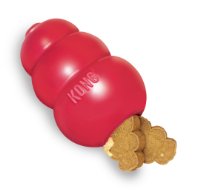
So what can you give your dog then?  The short answer is “it depends!”  For most dogs, the Kong toys are good, relatively indestructible, and safe toys to have.  Lining the insides with a little peanut butter (little is the key word), or some wedged in milk bones, or “Kong filling”, will make them more interesting, and can be engaging for a long period of time.  Nylabones, gummabones, and Galileo bones are generally safe to use because they are not edible per se so they last longer.  Sometimes to get a dog interested in these bones you have to hold one end until they start to make a dent in it.  After that, it becomes a real job for some dogs and can take weeks to months to “finish” the job.  One should throw these away when they become small enough to accidentally swallow whole. 

Photo Source: performancepet.net
Rawhide can also be enjoyable and good for their teeth.  The size and shape of the rawhide are important to consider. The flat or rolled strips are probably the safest, but one should observe your dog to be sure they actually chew them rather than try to swallow them whole, or bury them in the yard.  Avoid rawhide with knotted ends, as the end can come off and be accidentally swallowed whole.  If a rawhide is not chewed up first, it certainly could cause an obstruction.  Some are also coated with flavoring which can stain a light colored carpet or cause indigestion.  Also, there are some dogs with food allergies that cannot have these items.

Photo Source: missourilife.com
Greenies are good if your dog chews them, but if they are swallowed in large chunks or whole, they can lead to esophageal or intestinal tears or blockage.  This is more of a concern for smaller dogs.  The important thing to remember is that whatever chew toy you pick for your dog, watch them first to be sure they chew it as intended, and that they don’t have indigestion afterwards.

 Chewing is an important activity for dogs.  It often keeps them from gnawing on your furniture or on your feet!  If you hold one end of a chew toy, it can be a connection between you and your dog in a safe and fun way.  But an important thing to teach your dog is to release the toy when necessary.  This is something that is easy to train your dog to do with a replacement of a treat.  "Release" or "Leave it" are important commands whether it is a toy or an expensive new shoe that needs to be released!


Friday, December 07, 2012

Can I Make Cookies For The Dogs?

A few years ago, a coworker of my husband’s, who knew we had 4 dogs, gave us some recipes for dog biscuits that his wife had tried making and their dog loved. At the time, basketball and rugby and other children related activities took more of my time and I put the recipes in a drawer. The other day I found them; now that the kids are out of the house, I have time to pamper my dogs! So today I am going to make the Peanut Butter Oatmeal Dog Biscuits:
(The recipe I used came from this website: http://www.nittanygreys.org/?page=depot&id=196)

Peanut Butter Oatmeal Dog Biscuits
• 1½ cup hot water
• 1 cup quick cooking oats
• 2 cups whole wheat flour
• 2 Tbsp vegetable oil
• ½ cup peanut butter
• ¼ cup wheat germ

1. Pour hot water over oatmeal and let cool to lukewarm.
2. Stir in oil and peanut butter.
3. Add wheat germ and enough flour to make stiff dough.
4. Roll on floured cutting board to 3/8" inch thick.
5. Bake for 3 to 3½ hours at 250 degrees, flipping every hour until thoroughly dry.


The recipe is not hard to follow.  One thing to remember is that if they don’t get hard and dry enough (i.e. they are still a little soft after baking), they should be refrigerated or they could eventually spoil.

There is something about preparing our own food, and in this case, our pets’ food, that is appealing. It feels more “natural” and wholesome. If we have the time and resources, it seems like a reasonable thing to do. But wait, do we really know the nutritional needs of our pets as well as our own? The answer is no. Dogs and cats are not little people; foods that may satisfy our needs are not necessarily the ones that will satisfy theirs. In addition, there are many foods that are not well tolerated by our domesticated canines, and the variety of breeds makes one canine not like another. A Chihuahua or a Miniature Poodle is not going to have the same tolerance as a Black Lab or a Great Dane. Some things are the same.  However, if you are a veterinary nutritionist, you will know what those things are.

UC Davis has a Nutrition Support Service that can formulate a homemade balanced diet for your pet on an individual basis. The cost for a recipe is about $250 but if you follow it, you can be assured that your pet will be fed a well-balanced and supportive diet. However, if you change or substitute ingredients, you will change that balance and they suggest revising the formulation. Dog food companies that have research facilities associated with them will also invest in developing these recipes. They perform trial feeding studies that will actually test the efficacy of their diets over time. Not all companies will do this testing and this is something to keep in mind. Much of what you buy commercially is based on extrapolation from data acquired through previous research. Still, a pet food company whose business depends on providing a healthy diet for our pet, vs. me, the individual, who guesses at what my dog should eat, is going to produce a different result.

So I am going to feed my dogs these cookies as a Treat. That means they will only get a few.  I will wait to be sure they tolerate them and don’t develop soft stools, gas, or throw up on the rug. Then maybe tomorrow they will get another one. I won’t give them too many just as I wouldn’t give my children too many cookies, and I will still feed them their regular diet.
Like most things in life, moderation is a good rule to follow. If you are so inclined, enjoy baking for your dogs this holiday season but don’t indulge them too much. Ho ho ho!

Friday, November 16, 2012

Thanksgiving: Vomit, Diarrhea, & Vet Bills--oh my!

The day after Thanksgiving is often a busy day at veterinary hospitals. For many of us, this once a year holiday celebrated by wonderful food and over-indulgence for “just one day” spills over to the household pets as well. It is very tempting to give the dog(s) just a little turkey, or some of the gravy, or some of the sweet potatoes, and pretty soon, a little becomes a lot. Kind of like what happens to my plate! And after smelling the aroma of roasting turkey, fresh baked rolls, and pumpkin pie all day, what dog doesn’t feel entitled to a few samples?

But for many dogs, especially some with more delicate palates, this adventure into once a year indulgence is not easy to stomach—literally! Almost half of the calls in to the hospital, if not more, for the next two days will be related to vomiting and diarrhea. And it can get messy. If you are lucky, your dog or cat will only present one or two piles for you to clean up. If you are not so lucky, you could be cleaning all night, and into the next day.

Luckily, most cases resolve relatively quickly. In a few days, with proper diet adjustment, and sometimes a prescription to help, things do go back to the way they were. But sometimes things don’t get better so easily, and our pet becomes lethargic, dehydrated, and painful. The possibility of developing a pancreatitis is very real for dogs. They are creatures of habit and their guts are too. When dogs eat foods they are not used to digesting, and especially if the food is rich and heavy in fats, they can over stimulate their pancreas and it becomes inflamed. With inflammation there is a release of digestive enzymes into the abdominal cavity which can cause extreme pain, and in some cases, even auto digestion within the abdomen. When cats eat foods they are not used to, it creates inflammation in the stomach or intestinal tract that can take weeks or months to resolve often also affecting the pancreas and the liver. In either case, the veterinary bills can be high and hospitalization for rehydration, lab work, and possible x-rays or ultrasound is almost always necessary. Without proper treatment, pets can actually die from pancreatitis.

Obstructions from bones are surprisingly not as common, but depending on the size or shape of the bone fragment as it goes down, relative to the size of the pet, it can be just as serious of a problem—and an urgent one. If there is a tear in the gut from a sharp shard, it can mean emergency surgery.


Most of us like to spend the remainder of the holiday weekend relaxing with family, shopping for bargains, and eating more leftovers. Let’s give ourselves every opportunity to do that and stay out of the veterinary emergency waiting room this holiday. My suggestion is to stick to the plan and don’t feed anything special to the dog, or the cat, unless it is part of their normal diet. Instead, treat them to a walk or a nice nap with their person. Both of these things will undoubtedly be part of your planned holiday experience anyway!


Photo Sources:
"Beagle with food"
Photo credit: http://www.flickr.com/photos/cseeman/4141224600/">cseeman
"Thanksgiving Meal"
Photo credit: www.flickr.com/photos/eraphernalia_vintage/2742871131/">EraPhernalia Vintage . . . (playin' hook-y ;o

Friday, November 02, 2012

Lumps and Bumps 2012


Lumps and bumps are not all the same.  One such lump, known as a cutaneous histiocytoma, is a skin mass that often appears seemingly all of a sudden in younger dogs, especially under 2 years of age.   The cause of the mass is unknown, and although it looks very much like a tumor, it may just be proliferative or reactive tissue, because most often they will regress on their own within a few months.  Sometimes it takes 2-3 weeks and sometimes up to 5-6 months to regress.  That can be worrisome because waiting that long on a true tumor that may not be benign is risky.   An aspirate and cytology or biopsy is recommended to confirm the diagnosis.  If you are lucky like Quincy, the happy 11-month-old Boxer in our picture, a cutaneous histiocytoma will regress on its own.  In Quincy’s case it took 2-1/2 months, but as you can see, the “lump” fully resolved on its own.  


Thanks, Quincy, for letting us share your story!

Tuesday, October 16, 2012

Trick or Treat Costume Contest!

 
TRICK OR TREAT COSTUME CONTEST WINNERS 2012!!
 
Hot Dog Kahlua with 50 votes!!


Kobi & Whitney Dressed Up with 43 votes!!
Peek-A-Boo Beauregard with 15 votes!!

Pumpkin Tori with 15 votes!!
Walphie is Wambo with 9 votes!!

Thank you for everyone who participated in this year's costume contest!! It was great seeing all the cute pictures that were submitted. Congratulations to our winners, we will be contacting you soon!


Lady Bug Dora

Dr. Aussie

Bear & Pumpkin Friends


Sheriff Happy Camper


Pretty Steeler


Skeleton Zetta

Butterfly Osa

Scarecrow Mickey Mulligan

Decorated Jasper


Aubie's Decorations


Donner the Wizard


Peppy Gangnam Style

Royal Chompers & Vela
Max & Roxy: The Pirates


Monday, October 08, 2012

Trick Or Treat!!!

It's Halloween time!  An exciting time for kids and grown ups who get to step out of their normal reality for one night, and are rewarded by feasting on chocolate and sweets.  What could be better? For dogs and cats, it can also be very exciting.  From your furry companion’s point of view, the night is filled with odd sights, smells, and sounds.
The doorbell rings almost every few minutes.  Strangers are collecting things that smell very sweet while wearing capes, sparkles, carrying light torches and laughing loudly.  All the while, odd material is velcroed onto my body or head.  I hear my name being called and whistling, followed by the bright flash of light.  Eventually the thrill passes and I can go back to hunting for skunks in the backyard, or cleaning my paws whilst lounging on my favorite chair.  Unless…
Dad seems distracted by all the kids in the other room examining their loot.  Without them suspecting anything, I have found the bowl of Mars delights. Perfect!  Oh, a shiny stick with ribbons for me to chew on.   It looks like a rope toy but it is slightly different.  Hey, help me get this Yoda suit off or maybe I’ll just chew on it until I can wiggle just a little…GULP!
And you get the picture.  Don’t forget that grapes and raisins can be toxic to some pets.  Other dangers lurk around this time a year such as chocolate, flashlight batteries, fairy tinsel, uncomfortable costumes, and yes, skunks!  Skunks seem to be out in force every Halloween, judging from the number of people calling for recipes to bathe their dogs with the following day.  By the way, nothing will totally get skunk spray out except time; however, lemon juice, baking soda, hydrogen peroxide and a little dishwashing liquid or shampoo is a good starting place.  It can bubble up so be careful. 
The bottom line: keep your pets safe, indoors, and away from the goodies until once again, sanity returns on November 1st (Ahahahahahaha!).
 

Wednesday, September 05, 2012

Do I Need to Microchip My Pet?

The Importance of Microchipping


Lyza Jane is a sweet, indoor cat, who loves to cuddle and voices her opinion daily.  When she was six years old, she snuck out of her home.  Checking out the neighborhood, she realized that she had traveled too far from her residence.  One of the houses that she had checked out had a kitty door that was open.  Wandering into the house, she became distressed when she realized that this was not her home; however, she was a good cat and tried to blend in with her new environment.
The owner of the house came home and found a cat that didn’t belong to her!  She called Elk Grove animal control, which then took Lyza Jane to the SPCA.  She was scanned for a microchip and the SPCA facility cheered when they realized she had one.  They made Lyza Jane as comfortable as possible and then immediately called the phone number that was registered to the chip.
Suzanne, a technician at Hatton Veterinary Hospital, received the call from the SPCA.  She was extremely relieved to hear that Lyza Jane was found!

Statistics show that one out of three family pets will be lost.  Unfortunately, only 10% of lost pets are identified.  Most people believe that it could never happen to them, but the facts do not lie.

¨Every two seconds, a family pet is lost and most never make it back because their owners could not locate them.

¨Shelters are already overcrowded; so lost pets can only be kept for a short period of time.

¨ More pets die because their owners are unable to locate them than from all infectious diseases combined.

¨ A microchip provides peace-of-mind that in case of an unforeseen event, your pet can be safely reunited with you.

            Elk Grove Animal Control now requires that all licensed animals be microchipped.  According to the animal licensing requirements, “all applicants for such license shall procure and deliver a certificate issued by a duly licensed veterinarian, certifying that each dog or cat to be licensed has been administered an anti-rabies vaccination and has had a microchip inserted prior to the issuance of said license for the current license period.”

Microchips benefit all pets and their owners.  The microchip implanted in your pet contains a personal, one-of-a-kind identification number that identifies your pet and proof of ownership.  For example, your pet can become lost due to a fence falling during a storm or by escaping from the yard.  Without a microchip, if your pet’s collar comes off, or tags are lost, there is no identification that will provide adequate information about where he or she belongs.  A microchip registered in the microchip database can provide more information than can be written on a tag.  Microchips will ensure that you and your pet will be reunited without delay.  A microchip is a safe, simple, effective, and permanent form of identification to help your pet find its way back home.

Lyza’s story is just one of the thousands of stories of pets with microchips that found their way back to the loving arms of their owners.

References:


Friday, August 24, 2012

A Tribute Blog: Lightning, the Hospital Cat

Written by: Suzanne Mead, RVT

In the summer of 1994, less than a year after we opened, Lightning came to us as a kitten in need.  Some of the current staff was here when he first came in.  His housemate, a big lab, was a little too exuberant for poor, tiny Lightning and he came to us limping.  We did not find any serious injuries, but the owner did not think he was safe at their house any longer.  Lightning worked his charm on all of us, most importantly Dr. Hatton, who finally decided he could be our hospital cat. 


As a kitten, he got into EVERYTHING, but we overlooked his mischief because he was so darn cute and loveable.  Ideally, a hospital cat should “earn his keep” by being tolerant to different treatments.  That way, we could demonstrate procedures with him to show other pet owners.  Lightning did not agree!  He loved all his caretakers, but being a cat, he called all the shots! 


He did not like strangers or even well meaning clients.  It was quickly obvious that we would provide his every need but he had no obligations to us except for affection on his terms.  For almost 18 years, he was a constant source of joy, frustration and always entertaining.  Lightning decided (on his terms as always) it was his time to leave us this past May.  He was a member of our family, and we will never forget him!  Rest in peace Lightning, we love you and miss you!


Thursday, August 02, 2012

Our Senior Pets

Having a senior pet is quite different than a younger pet for many reasons.  Not only is there a stronger emotional bond after living together for many years, but the aging process in animals happens so much quicker than it does for people that it sometimes feels “sudden” that they are now “old.”

Like people, pets can cling to old habits and mentally, they may want to do the same things they have always done (run with you, go to the park, eat everything they are presented with, jump onto the bed or couch, etc.), but physically, those things may become more difficult to do.  Sometimes it is a challenge to relearn how to get onto the bed more safely, or when to stop running for the ball.  As their caregivers, we also have to be reasonable about what we ask them to do.  We may need to adjust our routine, walk a shorter distance with them, put a step stool or bench at the end of the bed, or provide a lower perch or more steps up to the cat post.  We may need to be more careful about the foods we offer, raise the food bowl, or put down non-slip floor mats to help them eat or drink on their own.  We also can be careful not to over feed them (out of love) to the point that it is more difficult for them to move (or even breathe!) sometimes. 
When we think our pets are no longer as comfortable as they once were, it is a reasonable time to have a discussion with your veterinarian about their quality of life and what options are available for comfort care.   More frequent visits and health checks to ensure they don’t decline prematurely just makes sense.  Sometimes medication can be recommended to help with arthritis, or alternative treatments for indigestion or incontinence.  Often we assume that age may be the reason for their lethargy, or weight gain, or incontinence, and fail to see that it is actually a correctable medical problem that could be the beginning of something worse if unchecked.   Or maybe one just needs reassurance that what we are seeing is a normal aging process rather than a medical or behavioral issue.  And occasionally it is time to consider whether a pet is actually suffering or not. 
It is not easy to contemplate euthanasia.  The fact that our pets’ life spans are shorter than ours makes it likely that if we are lucky enough to have a pet reach their senior days in our care, we will need to consider the option of euthanasia to help them transition “to the other side” as humanely as possible.  We recognize the importance of allowing our pets to pass with dignity and without pain.  One of the questions I always ask myself is if my pet is still having more good days than bad, and whether or not they are able to appreciate the things in life that they normally enjoy (e.g. spending time with their people, eating, drinking, resting).   If the time comes when that is no longer the case, and we can’t mitigate the discomfort, euthanasia may be the best for our beloved pet.   I encourage you to have a discussion with your veterinarian and your family about what is best for your pet, and for you.  It is not the same for everyone.   We have all hoped that somehow Fluffy would pass quietly in the night, but unfortunately that rarely happens.  Our pets give us years of unconditional love.  They depend on us to help them with their transitions as much as we are able.  
But in the meantime enjoy the journey because it is sooo wonderful!  Don’t you agree??