Thursday, May 16, 2013

Every Pet Deserves a Chance: Jeanette's Senior Project

Jeanette came to our hospital this year to observe our hospital in action.  She witnessed countless surgeries, observed on many routine appointments, and met lots of furry companions.  Jeanette is greatful for the opportunity, and we are happy she is able to get a closer view of her dreams.  Here is her story and pictures from her Senior Project.


"My name is Jeanette Cruz and I am a senior at West Campus High School. I have a single passion beyond all passions and that is animals. All my life I've wanted to pursue one career and that is to be a veterinarian. Helping animals in any way that I possibly can is second nature to me, it makes me happy and that is all that I ever want to do.
That being said, for my senior project, I wanted to make sure that I not only did something that made myself happy but also benefited what I love most in this world: the animals. I not only wanted to shadow the doctors and technicians at Hatton for my own personal benefit, to assure that I have been right about my ideal future, but I wanted to help the animals of low income families at Hatton in anyway that I could. My family struggles just like several others do, but I believe that the health of our pets should never be put on hold. For my senior project, I created a fund titled Every Pet Deserves a Chance. This fund would benefit animals of low income families in any way that it possibly could; for even just helping a single animal would mean the world to me. I asked for donations all around school, my work, and around my family members, I even held a bake sale to raise funds. In just 11 days, I raised $401.51. Every pet truly does deserve a chance and I am honored that I will help even just one."
 

Thank you Jeanette for letting us tell your story!!!
Sincerely,
The Doctors and Staff at Hatton Vet
 

Wednesday, April 24, 2013

Mew's Leg 2013


On February 19, 2013 “Mew”, a less than one pound Chinchilla with big brown eyes and large round ears and the softest fur, presented with a midshaft  tibial fracture of his left leg.  His owners were an equally adorable but worried family of seven, four of whom came with Mew that day, and now looked back at me with 8 more big brown eyes and very worried expressions on their faces. 
Mew had presumably caught his leg on the edge of the cage while they were out, and apparently had struggled enough to cause the injury.  We weren’t sure what could be done but after taking an xray and confirming the fracture, we decided to try a stabilizing splint known as a Thomas Schroeder splint to help his fracture heal.  I had used them before on birds, dogs, cats, but not yet a chinchilla. 

 
Photo Source: http://cal.vet.upenn.edu/projects/saortho/chapter_15/15F8.jpg
 
Mew’s family was determined to try to save the leg if possible, and so we began.  Mew was anesthetized to allow us to place the splint which we had fashioned from a thick wire coat hanger, and tape.  The fracture site had to be immobilized at the joints above and below the fracture for it to heal.  In this case, that would be Mew’s knee and his ankle.   After securing the splint, the question remained as to whether he would chew it off, and/or hurt his other leg or pelvis due to the weight and awkward nature of the splint.  If only we could explain to him that it was for his own good!
Mew’s family was wonderful and did a great job making sure he would eat, giving him a chance to have a limited dust bath with supervision, purchasing and feeding critical care food to syringe feed him to supplement calories during recover, and redesigning his customized “Elizabethan collar” several times to give him the more comfort while still protecting the wrap during the expected 6 week recovery period.  He had to come in weekly for bandage changes as well.

At first it wasn’t clear that he would adapt to the whole ordeal but he was a real team player and pulled his weight.  He tolerated all we did to him and didn’t seem to complain although we all knew it wasn’t his nature to be limited in such a way.  The 5th week of recovery, so close to the finish line, something terrible happened.  We had started using a lighter splint for the leg once a good healing callous on the bone could be felt, but somehow, the wrap slipped and he ended up breaking his femur.  This is the bone above the knee, above the tibia, and while the original fracture was nearly healed, this new one was potentially much harder to repair. Not only that, but Mew had just gone through a difficult 5 weeks.  Could we really ask him to do that again even if a new splint could be created? 
After discussion of the pros and cons, it was decided that we would amputate Mew’s leg and hope that he would be happier as a three legged Chinchilla than a splinted Chinchilla.  He did amazingly well with surgery and seemed to be much happier even in the immediate recovery period post op.  He came in a few weeks ago to have his stitches out and he had gained weight, was looking much brighter, and seemed to have his big brown shiny eyes back! 
His family is very dedicated to little Mew and he is now a happy go lucky Chinchilla again.  Thank you for letting us share his story!


Watch Mew's video!!  He's so fast--even on 3 legs!!!
 

Wednesday, April 03, 2013

Can A Dog Swallow A Whole Tennis Ball?

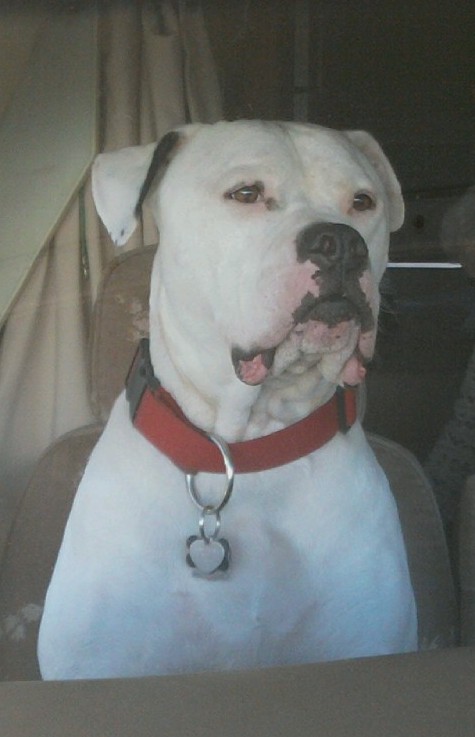
The answer is yes!  Last week, Bubba (appropriately so named before being adopted), a nearly 100 lb. American Bulldog did just that.  He is known to play with balls of all types, and has on more than one occasion chewed up and swallowed tennis balls.  To try to avoid problems with this, his new owner has given him larger doggie basketballs and soccer balls to play with, but last week he somehow found another tennis ball.  A few days later, the owner noticed Bubba was very lethargic and wouldn’t eat.  This of course was not normal for Bubba.  When he came to the hospital, he was depressed and dehydrated.  He loped around and looked several years older. 
After a brief discussion with the doctor, it was determined that an xray would be helpful to be sure the tennis ball had not ended up in the stomach or small bowel where it could be stuck.  Luckily unlike some balls, tennis balls and golf balls show up pretty well on xrays.  This is what we saw:


The tennis ball was still in the stomach, and probably couldn’t pass causing poor Bubba to vomit whenever he drank or ate anything.  After a day or two of this, he stopped trying to eat or drink and he became very dehydrated.  After starting him on an IV and replenishing fluid losses, he started to feel much better.  Bubba went into surgery to have the tennis ball removed from his stomach.  As you might suspect from the picture, it didn’t smell very good either!
 
 After a few days recuperating in the hospital, Bubba is now back to being a happy big dog with lots of spunk and charm.  Tennis balls are all removed from the yard, and toys 3 times bigger than his mouth are now the norm.
Good luck Bubba!


Thursday, March 28, 2013

Dear Otis…

Today we learned that despite our best efforts and a team of many talented doctors and staff, and a devoted and loving family, Otis passed away last night.  He was a rescued Sphinx kitty who had an extremely endearing personality, the most fragile eyes, and a huge heart.  Although Otis had not stopped eating, or developed any other apparent gastrointestinal symptoms (like vomiting or diarrhea), he started losing weight over a few months fairly rapidly.  His little wrinkles became more noticeable. After a few tests, it was discovered that he had a rapidly growing intestinal mass.  He went to surgery immediately, and yet within a week, he had to have a second procedure because the mass was growing that quickly, and it had led to a perforation of his bowels.  Despite a valiant fight, we lost Otis last night at around 9:30 pm in the ICU.  The mass was identified as a form of lymphoma.  The prognosis with chemotherapy was about 6 months to up to 1-2 years, depending on the type and his response to treatment, had he survived the initial surgeries.  His gracious owners were prepared to go all the way with this little guy, but in the end, the disease was too much and his body too weak to comply. 

Today we mourn the loss of yet another heroic creature, who lived, loved, and shared his life with us.  We will have to celebrate that, as best we can, for it is indeed, the most precious gift of life there is. 

 
Dear Otis,
Thank you for sharing with us.
The Staff and Veterinarians at Hatton Vet Hospital.

Wednesday, February 06, 2013

Chocolate & Dogs Don't Mix

Photo source:
With Valentine’s Day around the corner, be careful not to let your dog find your chocolate stash!  Just a few ounces of semisweet chocolate for small dog could be lethal.  The main culprits that can be toxic to dogs are theobromine and caffeine.  These can cause tachycardia (a dangerously fast heart rate), seizures, and in worse case scenarios, even death.  Chocolate often has sugar and fat associated with it which can also lead to vomiting and diarrhea, and pancreatitis.  But it is tasty, and dogs have such a keen sense of smell that even well wrapped or hidden chocolate is not a secret to them!

Check out this interactive chocolate chart: http://ngm.nationalgeographic.com/2007/10/pets/chocolate-chart-interactive


Friday, February 01, 2013

Galina!

Galina is a happy contented 18 month old kitty that had as part of her morning routine, racing up and down the steps of her two story home after her ball.  One owner would stand at the top of the stairs and catch a little ball her other owner would throw up from the kitchen, and back and forth she would go.  It was great exercise and totally fun for Galina, until one morning, two weeks ago…

Galina’s owners heard a loud thump as she was bounding up the stairs.  Galina stopped short when they came over to see what had happened, and then quietly walked over to her bed and laid down.  Her owners made sure she was breathing, looked alert, seemed not to be in pain, and let her rest.  When afternoon arrived and she had still not come out to the kitchen for her breakfast, nor moved much from her spot from the morning, they brought her to the hospital to have us check her out. 
Outwardly, Galina seemed to be fine. There was no evidence of bruising or soreness anywhere.  She didn’t have a fever.  Her heart and lungs sounded normal and her mucus membranes were pink.  No signs of a broken tooth, but wait.  Her front teeth looked a little askew, as if they didn’t fit into each other normally.  The lower teeth seemed to be shifted a little to the right.  She could still close her mouth but was reluctant to open it.  With a little more investigation, we noticed a mild swelling over her left jaw and wondered if the loud thump could have been her head hitting the step and causing injury to her jaw.  We weren’t sure if there was a fracture or dislocation, but her lower jaw seemed to be the problem.

We referred Galina to a specialist to be sure that we would only need to anesthetize her once, to both diagnose the problem with xrays, and treat it simultaneously should there be a fracture or more complicated repair.  It turned out that she had dislocated her left TMJ (temporomandibular joint).

Note the slight rotation of the lower jaw/teeth to the right as compared to her upper teeth (red arrow), and the larger space at the left TMJ (white arrow) vs. the right in this “before” xray:


 The surgeon was able to perform a “closed reduction” under anesthesia and reset the jaw:

 Notice how the canine teeth fit together symmetrically now (red arrow), and the TMJ’s are also symmetrical now (white arrows).
A closed reduction refers to a procedure whereby the joint is reset without opening the site surgically.  In order to prevent the joint from slipping out of position again, while the ligaments that normally hold it in place healed, the surgeon opted to place a large gauge non-absorbable suture across the bridge of  her nose, through her mouth inside her upper and lower lips, and secured under her chin.  She could open her mouth a little bit to lap up water and soft food, but could not open her jaw fully.  She also had to wear a plastic Elizabethan collar to prevent her from pulling out the suture.  As you might imagine, this was quite an adjustment for Galina!
After a few days at home it became clear that she was not going to eat on her own, nor would she drink water.  She became dehydrated, and constipated, and then started vomiting.  Her supportive care during her recuperation became difficult to manage at home, so Galina spent several days in the hospital so that our nurses could syringe feed her and keep her hydrated until the suture could be removed. 

After 10 days we removed the suture and while she was still on soft food for another week, she returned to quite the happy kitty again, able to clean herself, and open her mouth freely.  In about 3-4 more weeks, we can be pretty comfortable that she will not risk dislocating her TMJ without another serious impact. 
Her owners have learned a lot about cats through this experience:  how much they do not like “hats”, or having their jaw sutured closed, how they vomit sometimes when constipated, how finicky they can be about food, and how appreciative they are for attention when they want it.  Thankfully her ordeal is now behind her.  Good luck Galina!


Tuesday, January 15, 2013

Chew This, Not That!

With National Dental Health Month right around the corner, it seems fitting that we should talk a little bit about what types of chew toys are good for dogs.  The only problem is that not all dogs are made the same.  The chewing needs and tolerance for a Staffordshire Terrier are quite different from that of a Cocker Spaniel or Dachshund.  And the types of toys that will hold their attention can vary as well.

Photo Source: alldogblog.com
“Natural” products always seem to be crowd pleaser for a lot of dogs, but they are not all equally palatable--literally.  Pig ears tend to be very fatty and diarrhea is a common consequence to their consumption, and therefore something I would avoid.  I liken it to eating a bag of pork rinds.  These may be tasty, but not so good for the digestive tract.  Bully sticks have become popular again, but do you really want your dog chewing a bull penis for an hour? And for the smaller dogs, oftentimes the bone fragments come through with significant irritation to the colon/intestinal tract.   Some dogs are such aggressive chewers on hooves and antlers that they actually fracture their teeth chewing on these.

Photo Source: arcatapet.com
At the other end of the spectrum, soft toys with stuffing and squeakers can also create a problem if they are taken apart and the pieces are then ingested.  The stuffing/matting in these toys can be difficult to pass and get caught in the intestines.  The squeakers are particularly unforgiving and can sometimes lead to obstructions that have to be corrected surgically. 

Photo Source: amazon.com
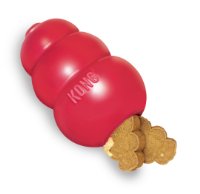
So what can you give your dog then?  The short answer is “it depends!”  For most dogs, the Kong toys are good, relatively indestructible, and safe toys to have.  Lining the insides with a little peanut butter (little is the key word), or some wedged in milk bones, or “Kong filling”, will make them more interesting, and can be engaging for a long period of time.  Nylabones, gummabones, and Galileo bones are generally safe to use because they are not edible per se so they last longer.  Sometimes to get a dog interested in these bones you have to hold one end until they start to make a dent in it.  After that, it becomes a real job for some dogs and can take weeks to months to “finish” the job.  One should throw these away when they become small enough to accidentally swallow whole. 

Photo Source: performancepet.net
Rawhide can also be enjoyable and good for their teeth.  The size and shape of the rawhide are important to consider. The flat or rolled strips are probably the safest, but one should observe your dog to be sure they actually chew them rather than try to swallow them whole, or bury them in the yard.  Avoid rawhide with knotted ends, as the end can come off and be accidentally swallowed whole.  If a rawhide is not chewed up first, it certainly could cause an obstruction.  Some are also coated with flavoring which can stain a light colored carpet or cause indigestion.  Also, there are some dogs with food allergies that cannot have these items.

Photo Source: missourilife.com
Greenies are good if your dog chews them, but if they are swallowed in large chunks or whole, they can lead to esophageal or intestinal tears or blockage.  This is more of a concern for smaller dogs.  The important thing to remember is that whatever chew toy you pick for your dog, watch them first to be sure they chew it as intended, and that they don’t have indigestion afterwards.

 Chewing is an important activity for dogs.  It often keeps them from gnawing on your furniture or on your feet!  If you hold one end of a chew toy, it can be a connection between you and your dog in a safe and fun way.  But an important thing to teach your dog is to release the toy when necessary.  This is something that is easy to train your dog to do with a replacement of a treat.  "Release" or "Leave it" are important commands whether it is a toy or an expensive new shoe that needs to be released!


Friday, December 07, 2012

Can I Make Cookies For The Dogs?

A few years ago, a coworker of my husband’s, who knew we had 4 dogs, gave us some recipes for dog biscuits that his wife had tried making and their dog loved. At the time, basketball and rugby and other children related activities took more of my time and I put the recipes in a drawer. The other day I found them; now that the kids are out of the house, I have time to pamper my dogs! So today I am going to make the Peanut Butter Oatmeal Dog Biscuits:
(The recipe I used came from this website: http://www.nittanygreys.org/?page=depot&id=196)

Peanut Butter Oatmeal Dog Biscuits
• 1½ cup hot water
• 1 cup quick cooking oats
• 2 cups whole wheat flour
• 2 Tbsp vegetable oil
• ½ cup peanut butter
• ¼ cup wheat germ

1. Pour hot water over oatmeal and let cool to lukewarm.
2. Stir in oil and peanut butter.
3. Add wheat germ and enough flour to make stiff dough.
4. Roll on floured cutting board to 3/8" inch thick.
5. Bake for 3 to 3½ hours at 250 degrees, flipping every hour until thoroughly dry.


The recipe is not hard to follow.  One thing to remember is that if they don’t get hard and dry enough (i.e. they are still a little soft after baking), they should be refrigerated or they could eventually spoil.

There is something about preparing our own food, and in this case, our pets’ food, that is appealing. It feels more “natural” and wholesome. If we have the time and resources, it seems like a reasonable thing to do. But wait, do we really know the nutritional needs of our pets as well as our own? The answer is no. Dogs and cats are not little people; foods that may satisfy our needs are not necessarily the ones that will satisfy theirs. In addition, there are many foods that are not well tolerated by our domesticated canines, and the variety of breeds makes one canine not like another. A Chihuahua or a Miniature Poodle is not going to have the same tolerance as a Black Lab or a Great Dane. Some things are the same.  However, if you are a veterinary nutritionist, you will know what those things are.

UC Davis has a Nutrition Support Service that can formulate a homemade balanced diet for your pet on an individual basis. The cost for a recipe is about $250 but if you follow it, you can be assured that your pet will be fed a well-balanced and supportive diet. However, if you change or substitute ingredients, you will change that balance and they suggest revising the formulation. Dog food companies that have research facilities associated with them will also invest in developing these recipes. They perform trial feeding studies that will actually test the efficacy of their diets over time. Not all companies will do this testing and this is something to keep in mind. Much of what you buy commercially is based on extrapolation from data acquired through previous research. Still, a pet food company whose business depends on providing a healthy diet for our pet, vs. me, the individual, who guesses at what my dog should eat, is going to produce a different result.

So I am going to feed my dogs these cookies as a Treat. That means they will only get a few.  I will wait to be sure they tolerate them and don’t develop soft stools, gas, or throw up on the rug. Then maybe tomorrow they will get another one. I won’t give them too many just as I wouldn’t give my children too many cookies, and I will still feed them their regular diet.
Like most things in life, moderation is a good rule to follow. If you are so inclined, enjoy baking for your dogs this holiday season but don’t indulge them too much. Ho ho ho!

Friday, November 16, 2012

Thanksgiving: Vomit, Diarrhea, & Vet Bills--oh my!

The day after Thanksgiving is often a busy day at veterinary hospitals. For many of us, this once a year holiday celebrated by wonderful food and over-indulgence for “just one day” spills over to the household pets as well. It is very tempting to give the dog(s) just a little turkey, or some of the gravy, or some of the sweet potatoes, and pretty soon, a little becomes a lot. Kind of like what happens to my plate! And after smelling the aroma of roasting turkey, fresh baked rolls, and pumpkin pie all day, what dog doesn’t feel entitled to a few samples?

But for many dogs, especially some with more delicate palates, this adventure into once a year indulgence is not easy to stomach—literally! Almost half of the calls in to the hospital, if not more, for the next two days will be related to vomiting and diarrhea. And it can get messy. If you are lucky, your dog or cat will only present one or two piles for you to clean up. If you are not so lucky, you could be cleaning all night, and into the next day.

Luckily, most cases resolve relatively quickly. In a few days, with proper diet adjustment, and sometimes a prescription to help, things do go back to the way they were. But sometimes things don’t get better so easily, and our pet becomes lethargic, dehydrated, and painful. The possibility of developing a pancreatitis is very real for dogs. They are creatures of habit and their guts are too. When dogs eat foods they are not used to digesting, and especially if the food is rich and heavy in fats, they can over stimulate their pancreas and it becomes inflamed. With inflammation there is a release of digestive enzymes into the abdominal cavity which can cause extreme pain, and in some cases, even auto digestion within the abdomen. When cats eat foods they are not used to, it creates inflammation in the stomach or intestinal tract that can take weeks or months to resolve often also affecting the pancreas and the liver. In either case, the veterinary bills can be high and hospitalization for rehydration, lab work, and possible x-rays or ultrasound is almost always necessary. Without proper treatment, pets can actually die from pancreatitis.

Obstructions from bones are surprisingly not as common, but depending on the size or shape of the bone fragment as it goes down, relative to the size of the pet, it can be just as serious of a problem—and an urgent one. If there is a tear in the gut from a sharp shard, it can mean emergency surgery.


Most of us like to spend the remainder of the holiday weekend relaxing with family, shopping for bargains, and eating more leftovers. Let’s give ourselves every opportunity to do that and stay out of the veterinary emergency waiting room this holiday. My suggestion is to stick to the plan and don’t feed anything special to the dog, or the cat, unless it is part of their normal diet. Instead, treat them to a walk or a nice nap with their person. Both of these things will undoubtedly be part of your planned holiday experience anyway!


Photo Sources:
"Beagle with food"
Photo credit: http://www.flickr.com/photos/cseeman/4141224600/">cseeman
"Thanksgiving Meal"
Photo credit: www.flickr.com/photos/eraphernalia_vintage/2742871131/">EraPhernalia Vintage . . . (playin' hook-y ;o

Friday, November 02, 2012

Lumps and Bumps 2012


Lumps and bumps are not all the same.  One such lump, known as a cutaneous histiocytoma, is a skin mass that often appears seemingly all of a sudden in younger dogs, especially under 2 years of age.   The cause of the mass is unknown, and although it looks very much like a tumor, it may just be proliferative or reactive tissue, because most often they will regress on their own within a few months.  Sometimes it takes 2-3 weeks and sometimes up to 5-6 months to regress.  That can be worrisome because waiting that long on a true tumor that may not be benign is risky.   An aspirate and cytology or biopsy is recommended to confirm the diagnosis.  If you are lucky like Quincy, the happy 11-month-old Boxer in our picture, a cutaneous histiocytoma will regress on its own.  In Quincy’s case it took 2-1/2 months, but as you can see, the “lump” fully resolved on its own.  


Thanks, Quincy, for letting us share your story!

Tuesday, October 16, 2012

Trick or Treat Costume Contest!

 
TRICK OR TREAT COSTUME CONTEST WINNERS 2012!!
 
Hot Dog Kahlua with 50 votes!!


Kobi & Whitney Dressed Up with 43 votes!!
Peek-A-Boo Beauregard with 15 votes!!

Pumpkin Tori with 15 votes!!
Walphie is Wambo with 9 votes!!

Thank you for everyone who participated in this year's costume contest!! It was great seeing all the cute pictures that were submitted. Congratulations to our winners, we will be contacting you soon!


Lady Bug Dora

Dr. Aussie

Bear & Pumpkin Friends


Sheriff Happy Camper


Pretty Steeler


Skeleton Zetta

Butterfly Osa

Scarecrow Mickey Mulligan

Decorated Jasper


Aubie's Decorations


Donner the Wizard


Peppy Gangnam Style

Royal Chompers & Vela
Max & Roxy: The Pirates